
Luxury Hospitality Website Design: What Sets the World’s Best Hotel Websites Apart
There is a noticeable difference between browsing an average hotel website and browsing the website of one of the world’s leading luxury hospitality brands. On one, you’re looking for a room. On the other, you’re already imagining the trip.
Before you’ve checked availability, compared suites or even looked at the price, you have an idea of how the property is supposed to feel. You can imagine waking up there, sitting beside the pool, eating at the restaurant or looking out over the landscape. In some cases, you find yourself wanting to visit a destination that wasn’t even on your radar five minutes earlier.
That isn’t accidental.
For luxury hotels, lodges and resorts, a website isn’t simply an online brochure or a means of getting someone to a booking engine. It’s an extension of the guest experience and, for many guests, the very first interaction they’ll have with the brand.
Some of the world’s most recognised hospitality brands understand this exceptionally well. Looking at brands such as Aman, Six Senses, Belmond and Rosewood, there are some interesting similarities in the way they approach their digital presence — even though visually, their brands can be very different.
They sell the experience before they sell the room
One of the biggest differences between an average accommodation website and a great luxury hospitality website is what it chooses to sell first.
A conventional hotel website tends to lead with practical information: rooms, rates, amenities and availability. Those things are important, of course, but they’re rarely the reason someone dreams about travelling somewhere.
Luxury hospitality brands tend to start somewhere else entirely. They sell the feeling of being there.
Six Senses is a great example of this. Browse through its digital presence and you’re introduced not only to properties and rooms, but to wellness, food, culture, nature and experiences. The accommodation is part of a much bigger story about what your time there could look and feel like.

Six Senses places experience, destination and wellbeing at the centre of its digital storytelling rather than treating the room as the entire product.
This distinction matters whether you’re running a global hotel group or an independent five-suite lodge. A guest isn’t necessarily choosing between two beds. They’re choosing between two versions of how they could spend their holiday.
Your website has to help them imagine yours.
Luxury websites understand the power of restraint
One of the easiest mistakes to make when designing a hospitality website is assuming that because a property has a lot to offer, everything needs to appear immediately.
The result is often a homepage filled with competing messages: rooms, restaurants, spa treatments, wedding packages, special offers, activities, reviews, awards and multiple calls to action all fighting for attention.
Aman takes almost the opposite approach.
Its digital presence is remarkably restrained. Large-scale imagery is allowed to breathe. Copy is carefully considered and often concise. There is space around individual elements, and the interface doesn’t constantly demand something from the visitor.
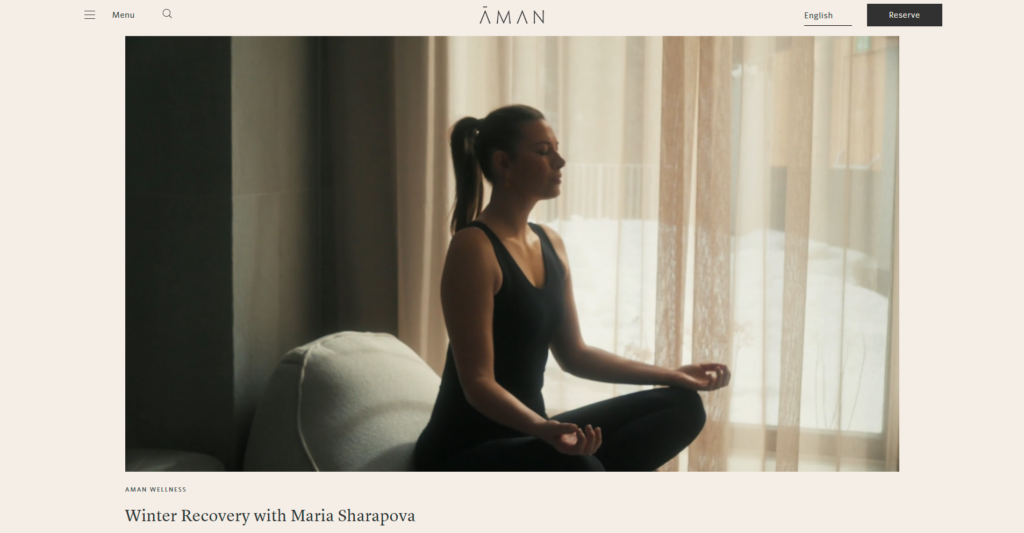
Aman’s website reflects many of the qualities associated with the physical brand itself: privacy, calm, space and considered simplicity.
This is something luxury brands understand particularly well. Luxury doesn’t need to tell you it’s luxurious every five seconds.
There is confidence in restraint.
That doesn’t mean every luxury website needs to be minimal or beige. A maximalist boutique hotel with an eccentric personality shouldn’t suddenly imitate Aman. The point is that the design needs to know what deserves attention and have enough confidence not to overwhelm the visitor with everything at once.
Photography isn’t decoration. It’s part of the product.
You can build an exceptional website, but you cannot completely design your way around poor photography.
This becomes especially important in hospitality because you’re asking someone to spend a considerable amount of money on an experience they haven’t had yet. They can’t feel the linen, smell the restaurant, hear the ocean or see how the afternoon light falls across the room. Photography and film have to bridge that gap.
Look at the digital presence of Aman, Belmond, Rosewood or Six Senses and you’ll notice that the imagery does far more than document what the rooms look like.
There are architectural photographs, landscapes, food, textures, people, tiny details and moments that don’t necessarily show you a feature of the property at all. Instead, they communicate atmosphere.

This is why professional hospitality photography should be considered part of a website project rather than something to think about once the website has already been designed.
If you’re trying to communicate a £1,000-a-night experience through badly lit cellphone photographs, there is only so much typography and beautiful web design can do to change the viewer’s perception.
For premium hospitality brands, the imagery isn’t there to fill the website.
It is doing a significant amount of the selling.
The best hospitality websites create a world around the property
Belmond is particularly interesting because its brand isn’t confined to conventional hotels. Its collection encompasses hotels, trains, river cruises and other travel experiences around the world.
As a result, browsing its website can become part of the discovery process itself.
You may arrive looking at a hotel in Italy and find yourself exploring a train journey you hadn’t considered. The brand isn’t simply asking, “Would you like to book this room?” It’s inviting you into a much larger world of travel.

Belmond’s digital experience allows individual properties and journeys to become part of a much broader brand story.
Independent hospitality businesses can learn a lot from this.
Your property exists within a destination. There are restaurants guests might visit, landscapes they’ll explore, local producers they’ll discover, cultural experiences they’ll remember and stories surrounding the place itself.
All of that can become part of your digital brand.
A beautiful boutique hotel in the Scottish Highlands isn’t simply selling a bedroom. A safari lodge in Botswana isn’t simply selling a bed and a game drive. A villa in Tuscany isn’t simply selling square metres and a swimming pool.
They’re selling access to a place and a particular way of experiencing it.
A great website understands the difference.
They treat their websites more like publications than brochures
Rosewood is a particularly good example of how hospitality brands can use editorial content to build a richer digital experience.
Alongside the information you’d expect to find on a hotel website, its wider digital presence explores destinations, food, art, culture and experiences. This gives visitors reasons to explore beyond simply checking rates and looking at rooms.
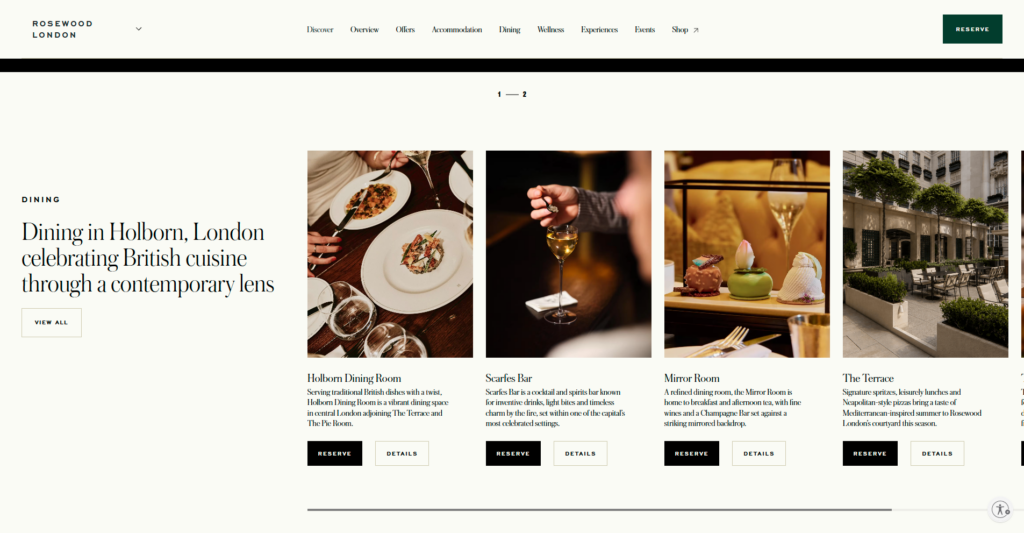
There’s an important lesson here for both branding and search visibility.
Hotels and lodges naturally sit on an enormous amount of valuable knowledge. They know their destinations intimately. They know when to visit, where to eat, what guests frequently ask, which experiences are worth travelling for and what makes their corner of the world different.
Yet many hospitality websites reduce all of that expertise to five or six static pages.
For SEO — and increasingly for visibility within AI-driven search and answer platforms — this is a missed opportunity.
A strong hospitality website can become a genuinely useful resource around its destination and speciality. Thoughtful articles about the location, experiences, food, architecture, conservation, wellness or local culture give search engines considerably more context about the business while also giving potential guests useful information during the research stage of their trip.
The important word, however, is useful.
Publishing twenty generic AI-written articles about “Top Things to Do in Cape Town” isn’t the same thing as demonstrating genuine expertise. The strongest hospitality content comes from knowledge that the property actually has.
Booking is easy, but it doesn’t take over the entire experience
Ultimately, a hospitality website has a commercial job to do. At some point, we want the person browsing it to check availability and book.
The world’s best hospitality websites don’t forget that. Booking options are generally easy to find and consistently available. What they don’t necessarily do is allow the booking engine to dominate every interaction.
There’s a subtle but important difference between making it easy to book and making your entire website feel like a booking engine.
Luxury purchases often require exploration. A guest considering an expensive stay may look at the suites, leave, come back three days later, read about the restaurant, send the property to their partner, look at flights, return again and finally make the booking.
The website has to support that journey.
A constant barrage of “BOOK NOW” buttons doesn’t necessarily make someone more ready to spend thousands on a holiday. Sometimes the better conversion strategy is giving them enough confidence and desire to reach that decision themselves.
Every detail supports the same positioning
There isn’t one design trick that makes a website feel luxurious.
It isn’t serif typography. It isn’t neutral colours. It isn’t enormous photographs. It isn’t slow-motion video or an elegant loading animation.
In fact, applying all of those things to the wrong brand can very quickly become a cliché.
What makes the strongest luxury hospitality websites feel so considered is the consistency between hundreds of smaller decisions.
The typography supports the brand personality. The photography supports the positioning. The copy sounds like the same business the imagery depicts. Animation has a purpose. Navigation feels intuitive. Calls to action use appropriate language. Mobile hasn’t been treated as an afterthought.
Most importantly, the digital experience feels believable when compared with the physical experience being promised.
This is one of the biggest misconceptions I encounter when businesses tell me they want a “luxury website”.
Luxury isn’t a design style that can simply be applied at the end of a project.
It’s positioning.
The identity has to support it. The photography has to support it. The language has to support it. The website has to support it. The service has to support it. And when the guest finally arrives, the actual experience has to live up to everything they’ve been promised.
Your guest experience begins long before check-in
A guest may experience your website weeks or even months before they ever walk through your doors.
They may discover you while absent-mindedly scrolling one evening, save the property, return later, show it to someone else and spend weeks deciding whether this is where they want to travel.
During all of that time, your physical hospitality can’t help you.
Your beautifully trained staff can’t greet them. They can’t taste the food. They can’t experience the view. They can’t appreciate the small details you’ve spent years perfecting.
Your brand and your website have to communicate that value on your behalf.
That’s why the digital presence of a luxury hospitality business carries so much weight. If you’re asking someone to invest significantly in an experience they haven’t had yet, your website needs to create desire while establishing enough trust for them to believe the real experience will be every bit as good.
The world’s best hospitality brands understand that their websites aren’t simply places to display rooms and collect bookings.
They’re the beginning of the journey.
And when they’re done exceptionally well, they don’t simply show you where you could stay.
They make you want to go.